The Ultimate No-Knead Peasant Bread: Effortlessly Delicious Homemade Loaves
You are about to discover a recipe that will transform your kitchen into a haven of warmth and delicious aromas. This **Peasant Bread** recipe is truly extraordinary, consistently earning rave reviews from everyone who tries it. It’s more than just bread; it’s a testament to how simple ingredients, when handled with a little love and minimal effort, can yield results beyond imagination.
Some recipes become staples, cherished for years, beloved by every member of the family. This easy no-knead bread falls squarely into that category. Prepare yourself, because this might just become your new favorite go-to bread recipe – one you’ll want to share with everyone you know.
I distinctly remember the first time I encountered this magical bread. It was several years ago when I was invited to a friend’s home for a casual lunch. My kids played happily in the backyard while we gathered around her beautifully set dining room table. The entire house smelled absolutely divine, a comforting scent that hinted at something truly special baking in the oven.
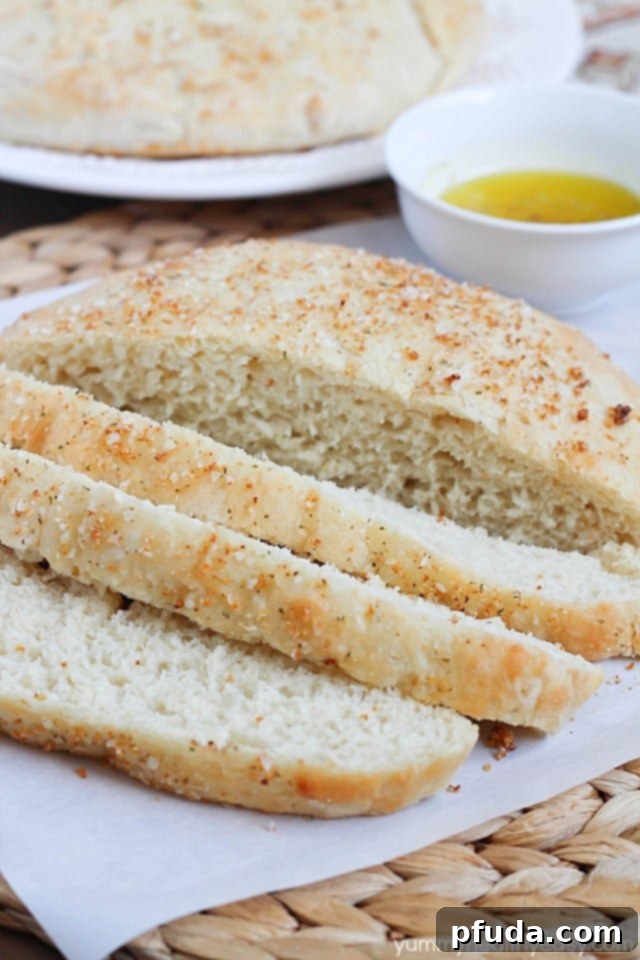
My friend disappeared into her kitchen, returning with a tray laden with the most magnificent loaves of peasant bread I had ever laid eyes on. They were perfectly round, with a rustic, golden-brown crust, promising yeasty goodness within. My mouth was practically watering as she placed the tray down. Alongside it, a small bowl of warm olive oil infused with garlic and savory seasonings awaited. It was an invitation to pure culinary bliss.
Without hesitation, I tore off a generous chunk of the warm bread and plunged it into the fragrant olive oil. The taste was unbelievable – a soft, airy interior contrasting with a wonderfully chewy crust, all enhanced by the garlicky oil. I ate so much bread that day, savoring every single bite, that I barely had room for the main course! It was a truly unforgettable experience.
Completely captivated by its perfection, I asked her where she had purchased such glorious bread. Her response stunned me: “Bought it? Oh no, I made it myself!” I nearly fell out of my chair. “No way! You *made* this?” I couldn’t believe that something so incredibly delicious and professional-looking could be homemade.
But yes, she absolutely did. She crafted that amazing, mouth-watering, perfectly textured peasant bread entirely from scratch. You can bet your bottom dollar I begged her for the recipe right then and there. It sounded too good, too simple, too perfect to be true. And yet, it was.
Why You’ll Fall in Love with This No-Knead Peasant Bread
This peasant bread recipe has since become one of our most beloved bread recipes, perhaps in the entire history of bread recipes! Its appeal lies not only in its sensational flavor and texture but also in its incredible simplicity. You genuinely won’t believe how easy it is until you try it yourself. With just a few basic ingredients and absolutely no kneading required, you can consistently produce perfect loaves of rustic bread every single time.
The term “no-knead” is not just a marketing gimmick; it’s the core of its genius. Traditional bread making can be intimidating for many, often requiring significant time and effort devoted to kneading the dough. This recipe eliminates that step entirely, relying instead on a longer fermentation period that develops the gluten structure and flavor all on its own. This means less work for you, and more time to enjoy the delightful process of baking and the incredible results.
Just the other day, I made a batch right before my boys came home from school. As soon as my oldest walked through the door, he immediately recognized the amazing, distinct aroma filling the house. “Mom! You made Peasant Bread!” he exclaimed, his eyes lighting up. Yes, it’s *that* good – memorable, comforting, and utterly delicious. I truly cannot wait for you to experience this simple joy.
The Magic of Simple Ingredients and the No-Knead Method
What makes this peasant bread so special is its reliance on fundamental, pantry-staple ingredients: yeast, warm water, sugar, salt, and flour. Each plays a crucial role. The yeast, a living organism, feeds on the sugar and ferments, creating the carbon dioxide that gives the bread its beautiful rise and airy texture. Warm water activates the yeast, while salt balances the flavors and strengthens the gluten network. Flour provides the structure. Together, these humble components create something truly magnificent.
The no-knead method simplifies the process dramatically. Instead of developing gluten through rigorous kneading, this technique allows time to do the work. A longer fermentation period, typically at room temperature, gives the enzymes in the flour and yeast ample opportunity to break down starches and proteins, naturally developing the gluten structure. This results in a dough that is surprisingly easy to handle and produces a bread with a wonderfully complex flavor and an open, airy crumb – qualities often associated with artisan bread.
Baking Tips for Perfect Peasant Bread Every Time
Achieving bakery-quality bread at home doesn’t have to be complicated. Here are a few tips to ensure your no-knead peasant bread turns out perfectly:
- Yeast Activation: Make sure your warm water is around 105-115°F (40-46°C). Water that’s too hot can kill the yeast, while water that’s too cold won’t activate it properly. The 10-minute resting period allows the yeast to bloom, indicating it’s active and ready to work.
- Don’t Overmix: When combining the ingredients, resist the urge to mix for too long. Just bring the ingredients together until a shaggy dough forms. The minimal mixing is key to the no-knead process.
- Rising Environment: Find a warm, draft-free spot for your dough to rise. This helps the yeast work efficiently. If your kitchen is cool, you can lightly warm your oven to 100°F (38°C), then turn it off and let the dough rise inside with the door slightly ajar.
- Grease Your Baking Sheet: A well-greased baking sheet will prevent your dough from sticking and help achieve that lovely golden-brown crust on the bottom.
- Egg Wash vs. Melted Butter: Both egg white and melted butter contribute to a beautiful crust. Egg white gives a shinier, crispier crust, while melted butter results in a softer, richer top. Choose what you prefer!
- Garlic Salt: Don’t skip the garlic salt! It adds an incredible layer of flavor and aroma that elevates this bread from good to extraordinary. California garlic salt is a personal favorite, but any good quality garlic salt will do.
- Oven Temperature: The initial high temperature helps the bread achieve a good “oven spring” – a rapid rise in the hot oven – before the temperature is reduced to ensure even cooking through to the center without burning the crust.
Serving Suggestions for Your Homemade Peasant Bread
This versatile peasant bread can be enjoyed in countless ways. As mentioned, we absolutely love tearing off warm chunks and dipping them in seasoned olive oil. It’s an irresistible appetizer or side dish. But the possibilities don’t end there:
- Soups and Stews: It’s the perfect accompaniment to hearty soups, chili, or stews, soaking up all the delicious broths and sauces.
- Sandwiches: Its sturdy yet soft texture makes it ideal for sandwiches, holding up well to various fillings.
- Garlic Bread: Slice it, slather with garlic butter, and toast for an amazing homemade garlic bread.
- Bruschetta: Toast slices lightly and top with fresh tomatoes, basil, and mozzarella for a quick and impressive appetizer.
- Breakfast Toast: Simply toasted with butter and jam, it makes for a comforting breakfast.
I hope you like it as much as we do! It’s truly a rewarding experience to pull these gorgeous loaves out of your own oven.
Peasant Bread
Print
Pin
Rate
Ingredients
- 1 package dry yeast 2 1/4 tsp. if measuring
- 2 cups warm water 110 degrees
- 1 Tbsp. sugar
- 2 tsp. salt
- 4 cups flour
- 1 egg white OR melted butter for topping
- garlic salt I use California garlic salt
Instructions
-
In a large mixing bowl, combine the yeast and warm water. Let this mixture sit for 10 minutes, allowing the yeast to fully activate and become foamy.
-
After 10 minutes, add the sugar, salt, and flour to the yeast and water mixture in the mixing bowl. Stir briefly until all ingredients are just combined and a shaggy dough forms. Do not overmix and absolutely do not knead. Cover the bowl with plastic wrap or a clean kitchen towel and let the dough rise in a warm, draft-free place until it has doubled in size (this usually takes 1-2 hours, depending on your kitchen’s temperature).
-
Once doubled, gently divide the dough into 2 equal rounds. Place them onto a greased cookie sheet or baking stone. Cover lightly and let them rise again until doubled in size, which may take another 30-60 minutes. During the second rise, preheat your oven to 425º F (220º C).
-
Just before baking, brush the tops of the risen bread rounds with either an egg white (for a crispier, shinier crust) or melted butter (for a softer, richer crust). Then, generously sprinkle with garlic salt.
-
Bake at 425º F (220º C) for 10 minutes. Then, reduce the oven temperature to 375º F (190º C) and continue to bake for an additional 15 minutes, or until the loaves are beautifully golden brown and sound hollow when tapped on the bottom.
-
Allow the bread to cool slightly on a wire rack before serving. We absolutely love tearing off rustic chunks and dipping them into a mixture of olive oil and your favorite seasonings. It’s so delicious and wonderfully satisfying! Enjoy your homemade perfection!
Need even more carbs? Check out these yummy recipes:
Easy Breadsticks with Warm Bacon Cheese Dip
Homemade Whole Wheat Pita Bread
Oatmeal Coffee Cake
For even more great ideas follow me on:
Facebook – Pinterest – Instagram – Twitter